
Learning & Teaching Resources
Teachers’ Information
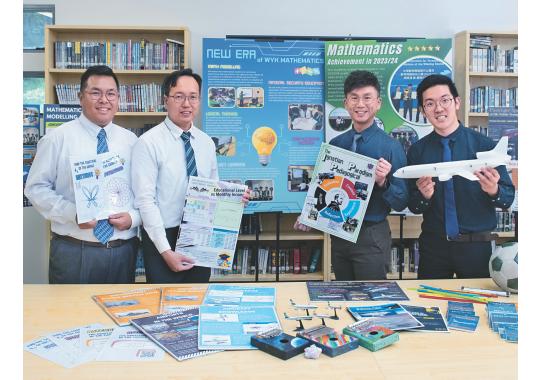
- Mr YEUNG Chun-yin, Mr CHUNG Wing-hong, Patrick, Mr LEE Yan-chuen, Andrew, Mr NG Chun-ngai, Lincoln
- Wah Yan College, Kowloon
- 2024/2025 Chief Executive's Award for Teaching Excellence (Certificate of Merit)
- Awarded Teaching Practices: Mathematics Education Key Learning Area
Teaching Philosophy
We believe that Mathematics education should go towards experiential learning to cultivate the essential 21st-century skills of creativity, digital literacy, problem-solving, and communication. Through mathematical modelling, we inspire our students to view society and the world through a mathematical lens, igniting their curiosity and empowering them to contribute to the greater good of the community
Teachers’ Sharing
Igniting minds with real-world mathematics
We believe that mathematics is not only about formulas and skills, but also a way for us to study our living world. Therefore, we have introduced mathematical modelling classroom activities to connect Mathematics with students' life experiences. We hope that students can broaden their horizons in mathematics with real-life examples and enhance their problem-solving skill, critical thinking and creativity.
Experience, reflection and action in mathematical modelling tasks
We have designed a series of modelling tasks for students in secondary 3 to 5. On the one hand, students are invited to apply Mathematics to their interests, such as using variation to study the relation between educational level and income, and using coordinate geometry to find the best shooting spot on a football pitch. On the other hand, they are asked to apply mathematical concepts to study our community, such as justifying the number of accommodations on Hong Kong's public transport by using ratios and assessing the accessibility of ramps in our community through application of trigonometry.
During the tasks, students are asked to reflect on their personal experiences and explain how their mathematical models correspond to real-life scenarios. They are also encouraged to continue exploring these problems outside of class and to view various topics in our society through the lens of mathematics. Experience, reflection and action are all integral to the Mathematics classroom and drive the entire learning environment.
Active and reflective learners
We take up a leading role to guide our students to become as self-directed and reflective learners, which facilitate the transformation of Mathematics knowledge from classroom to real-life situations. We are glad to see that some of our students have mastered the concept of mathematical modelling and create their own infographics to explain phenomena in our community, such as the Urban Heat Island Effect in Hong Kong. Ultimately, we hope that every youngster will take the initiative to integrate Mathematics to their lives and contribute to the greater good of our community.
Sharing of Resources
Teaching Practices
Learning and Teaching resources
- Examples of Mathematical Modelling Activity Worksheet :
- Secondary 3: Ramps on our campus
- Secondary 5: Shooting on the football pitch
- Examples of Students’ Work on Infographics about Mathematical Modelling :
- Passenger Space Ratio of Hong Kong Public Transport
- Urban Heat Island Effect
Related professional sharing
Compendium
Collaboration fosters synergy : The key to teaching excellence
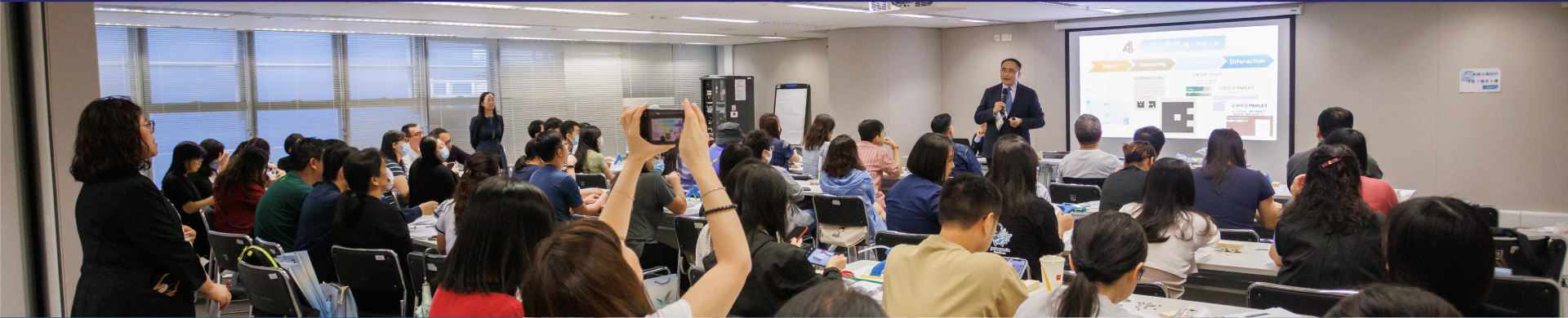
Open Classroom

Secondary 3 & 5 Mathematics - Open Classroom by Awarded Teachers of the Chief Executive's Award for Teaching Excellence ✐PowerPoint is available for download
26 / 5 / 2026
Open Classroom
Secondary 4 & 5 Mathematics - Open Classroom by Awarded Teachers of the Chief Executive's Award for Teaching Excellence ✐PowerPoint is available for download
29 / 4 / 2026